Categories
Sem categoria

BELA LX-404 – A Touching and Innovative Tribute to Léa Garcia

Last Saturday, October 6, the Rio Festival was lit up with the premiere of “BELA LX-404,” the highly anticipated short film written and directed by Luiza Botelho. Even though the screening was not in the official competition, the film stood out as one of the most exciting attractions of the event, also serving as a tribute to the legendary actress Léa Garcia, whose recent loss leaves an immeasurable absence in Brazilian cinema.

Léa Garcia, at 89 years old, gave life to Bela LX-404, a sensual robot acquired by a lonely man, Seu William (Thiago Justino). The choice of Léa for this role – a robot with touches of sensuality – not only defies William’s expectations, but also those of the audience. In a performance that mixes humor, humanity and a hint of irony, Léa captivates from start to finish. The actress herself confessed to having a lot of fun with the role, which is evident in each scene, making her performance even more captivating.

The plot, which begins in an almost comical way with William’s surprise at receiving a robot older than the attractive young woman he was expecting, evolves into a deeper reflection on human relationships, loneliness and acceptance. Henrique Bulhões stands out in the story as the doorman Zezinho, whose interaction with Bela and William adds layers of complexity and sensitivity to the film.

Luiza Botelho’s direction is a fitting tribute to her father, and a promising showcase of her own cinematic talent. The choice of the year of robots and the futuristic style is supported by the lighting work, which plays a fundamental role in transporting the viewer to a future where technology and human relationships intertwine in unexpected ways.

The visual effects, especially the futuristic technological screens, are noteworthy and add a layer of authenticity to the film’s futuristic setting. The post-production perfectly bridges the gap between the human and technological elements of the work, without ever taking the focus away from the moving performances and character development.

BELA LX-404 is a beautiful farewell to Léa Garcia, offering a last chance to appreciate the brilliance and versatility of an actress who left an invaluable legacy. The short film combines humor, emotion and innovation, leaving the audience not only entertained, but also reflective on the complexities of human relationships in a world dominated by technology.

Did you like the content? Then leave a comment to let me know!

See you in the next post.
Categories
Sem categoria

Emilia Perez

Highlighted at the Cannes Film Festival, “Emilia Pérez” is one of France’s strongest bets for the next edition of the Oscars, in the category of Best International Film. The film, which will only be released in Brazilian theaters in 2025, has won awards and critical acclaim. It recently opened the 26th edition of the Rio Film Festival, with sold-out screenings, reflecting the great enthusiasm surrounding the production.

Directed by Jacques Audiard (known for “Rust and Bone” and “A Prophet”), the film was shot in Mexico and is mostly spoken in Spanish. Emília Pérez blends elements of Mexican crime drama and musical to tell the intertwined story of two individuals in search of a brighter future: Manitas del Monte (played by Karla Sofía Gascón, Spanish actress from “Rebelde”), a drug cartel boss who dreams of becoming a woman, and Rita Moro Castro (played by Zoë Saldaña, from “Avatar: The Path of Water” and “Crash”), a discredited lawyer who sees the offer to help Manitas as a chance to transform her own life.

The pact between them requires Manitas to abandon his past in drug trafficking, including his family. For Rita, the responsibility of resolving the practical details of the plan generates a sense of urgency, which is reflected in the film’s fast-paced narrative. Soon, Manitas becomes Emilia Pérez, a transformation that not only changes Rita’s life, but also impacts the lives of two other women: Jessi (Selena Gomez, from “Only Murders in the Building” and “Wizards of Waverly Place”), Manitas’ widow, who finds herself trapped in a lie while trying to live with Emilia, and Epifanía (Adriana Paz, from “Vis a Vis”), who, in search of redemption, starts an organization to help missing people, since Mexico is one of the countries where the most people go missing.

Emilia Pérez explores these women’s journeys of self-discovery: Emilia faces the reality of finally living her dream, Rita navigates the complexity of achieving success and discovering her internalized emptiness, Jessi tries to find happiness again with another man (Edgar Ramírez), and Epifanía learns to live without fear and to love again.

Music is a central element of the film, organically inserted into the narrative to reinforce emotions and themes. Unlike classic musicals such as Moulin Rouge, Mamma Mia, or even Les Misérables, Emília Pérez’s soundtrack provokes a wide range of feelings, from intimidation and impact to discomfort.

It is worth noting that the cinematography and choreography are highlights of the film, further enriching the experience. The cinematography captures the nuances of the Mexican landscapes and the characters’ most intimate moments, while the choreography adds an extra layer of expressiveness and dynamism to the scenes. It is no wonder that Karla Sofía Gascón was awarded the Best Actress award at Cannes, a victory that underscores the strength and depth of the performances that characterize the feature film Emília Pérez.

With its innovative approach and rich human nuances, Emília Pérez promises not only to be a strong contender at international festivals, but also to win the hearts of audiences by exploring universal themes of identity, transformation, and redemption.


Categories
Sem categoria

Federer: 12 Final Days

“Federer: Twelve Final Days” is an emotional farewell to one of the greatest icons in world sport, directed by Asif Kapadia and Joe Sabia. This documentary is not just a retrospective of Roger Federer’s career, but a heartfelt and moving tribute to the man behind the racket, whose exploits on the court captivated millions around the world.

From the shocking moment of his retirement announcement, the film grips the viewer with an avalanche of emotions. We closely follow not only Federer, but also his family—his wife, children, and parents—and even phone calls from influential public figures and fans. The press conference that shook the sporting world in 2022 is portrayed with a sensitivity that highlights the magnitude of the moment.

Throughout the documentary, we see Roger Federer reflect on his personal and professional journey, revealing his insecurities after knee surgery—a phase he never imagined he would face. Kapadia and Sabia’s ability to capture Federer’s vulnerability adds a deep layer of humanity to the tennis legend. The struggle to regain confidence, the difficulties in long matches and the growing impact of his physical limitations are shown without filters, allowing viewers to understand the emotional complexity of an athlete facing the end of his competitive career.

The backdrop of the 12 days leading up to his final match at the Laver Cup in London is richly illustrated by Federer’s relationship with other tennis giants such as Djokovik, Nadal and Murray. These interactions, especially with his childhood hero Björn Borg, add a noble touch to the legacy Federer leaves behind. Even in his farewell, Federer promises not to “disappear and become a ghost” like Borg, reaffirming his continued commitment to tennis and its fans.

The editing of the film is one of the highlights. Kapadia and Sabia alternate footage of Federer’s epic games, including his legendary battles against Rafael Nadal, with home footage of a young Federer training with adolescent fervor. This visual narrative creates an intimate connection between the past and the present, highlighting the evolution of the player and the man.

“Federer: Twelve Final Days” is not just a documentary; is a tribute to the passion, resilience and indomitable spirit of an athlete who redefined modern tennis. It’s a powerful reminder of the lasting impact Roger Federer has had on sport and so many people’s lives. The emotion that permeates each frame leaves no doubt: this film is a celebration worthy of a legend.

Categories
Sem categoria

A Not So Happy Family

Next Thursday (April 4th) the film “A Happy Family” hits theaters. It reveals an intricate plot centered on Eva, a young mother faced with the devastating reality of postpartum depression in the midst of a community that quickly turns against her. With the script  written by Raphael Montes and directed by José Eduardo Belmonte, the film immerses viewers in a dark plot accentuated by meticulous lighting work.

With impactful performances by Grazi Massafera and Reynaldo Gianecchini, the The narrative reveals the family tensions and hidden secrets that threaten the apparent harmony of Eva’s life.
In “Uma Família Feliz”, the influence of “Aos Teus Olhos” from 2017, scripted by Lucas Paraíso, is noticeable both visually – from the film’s poster to the narrative construction – and in its emotional core. The film addresses in a striking way the dangerous dynamics of public lynching and the destruction of an individual’s life as the community closes in on suspicions and hasty judgments, without stopping to understand the truth behind the events.

Raphael Montes weaves a suspenseful plot that keeps the viewer tense and involved, gradually revealing the intricate secrets that permeate the lives of this apparently perfect family. The film stands out for its ability to explore the deepest layers of the human psyche and for the way it exposes the fragility of interpersonal relationships when subjected to the pressure of public scrutiny and irrational suspicion.

The feature film is a dense and engaging psychological thriller that echoes not only the visual and narrative features of “Aos Teus Olhos”, but also its powerful message about the dangers of rush to judgment and the destruction caused by public lynching. With a skillfully constructed narrative and a talented cast, the film delves into the shadows of the human condition, revealing how closely guarded secrets can become poisonous when exposed to the light.

“Someone has to actually work while your mother plays with dolls, son.”

It is necessary to reinforce the invalidation and lack of recognition of women’s work beyond the office, when she takes care of the house, her husband, 3 children and still has her personal life projects.

As Raphael Montes says: “I’m afraid of the evil citizen, but I’m more afraid of the good citizen.”


Categories
Sem categoria

Maestro(s) – A Symphony of Conflicts and Overcoming

Maestro(s), directed by Bruno Chiche and written by him in partnership with Yaël Langmann and Clément Peny, brings an intense narrative that delves into the complexities of the relationship between Denis Dumar (played by Yvan Attal) and his father, François Dumar (played by Pierre Arditi). The film, presented at the Varilux 2023 Festival, explores themes of prestige, fear, and the pursuit of excellence.

The plot unfolds with the impactful opening, highlighting two generations of maestros – one who takes the stage and another who recalls their memories. Denis, despite winning a prestigious award, finds himself grappling with the imposing shadow of his father, François, an internationally known conductor. The relationship between father and son is marked by fights, envy and comparisons, creating palpable tension throughout the film.

The photography is remarkable, with dynamic shots that capture the grandeur of the orchestra and the performance space. The close-ups on the instruments, especially the violins and strings, provide a striking soundtrack that accompanies the characters’ emotional journey.

The lack of dialogue in the relationship between father and son adds layers of complexity to the narrative. The question “How do you love a hateful person like me?” highlights François’ internal conflict, as he, rigid and demanding, struggles to understand his son’s true desire.

The plot develops through Denis’ dilemma between reaching the height of his career and facing his fears, or saving his relationship with his father. The film addresses universal themes of self-acceptance, overcoming fear and pursuing one’s dreams.

The triumphant resolution highlights the film’s central message – creativity and cooperation as the answer to challenges. Maestro(s) is a cinematic experience that resonates, reminding us of the importance of facing our fears to achieve our dreams.

You will find Maestro(s) in the official selection of the Varilux Festival which takes place from November 9th to November 22nd, 2023.

Did you like the content? So leave a comment to let me know!

See you in the next text.

Categories
Sem categoria

Driving Madeleine: A Poetic Journey Through the Streets of Life

Driving Madeleine,  directed and scripted by Christian Carion and presented at the Varilux 2023 Festival, is a cinematic experience that transcends the boundaries of simple narrative, taking viewers on a unique journey through the streets of Paris and into the deep recesses of human memory.

The film, starring Line Renaud and  Dany Boon, has a captivating and dynamic opening, presenting the daily life of taxi driver, Charles, played by Dany Boon. Every detail is inserted concisely, establishing an environment of urgency and vulnerability. Charles, on the verge of losing points on his license and facing financial difficulties, finds himself at a crossroads, seeking help in his complicated relationship with his doctor brother.

Charles’ meeting with Madeleine, a 92-year-old woman, changes the course of their lives. The film unfolds mainly inside the taxi, but maintains a dynamic and engaging pace. Christian Carion’s ability to create an intimate atmosphere inside the vehicle is remarkable.

The story develops as Madeleine shares her memories, revealing a life marked by challenges and overcoming. The flashbacks, masterfully and poetically constructed, offer the audience a deep insight into Madeleine’s past experiences, some painful, others reflective.

The film is a reflection on time, changes in the city, love and life itself. The soundtrack plays a key role, perfectly complementing the emotions evoked by Madeleine’s stories. Charles’ journey, initially impatient and closed, transforms as he is captivated by the passenger’s narratives, revealing a lighter and more open man.

The script skillfully addresses sensitive themes, such as domestic violence, love and loss, without losing tenderness and humanity. The cinematography takes the viewer through different locations in Paris, like an invitation to an emotional city tour.

Driving Madeleine is more than a film; is a cinematic experience that breathes life into the intertwined stories of two unlikely characters. With a surprising emotional twist and a conclusion that echoes the ephemerality of existence, it is a breathtaking film.

You can find Driving Madeleine in the official selection of the Varilux Festival which takes place from November 9th to November 22nd, 2023.

Did you like the content? So leave a comment to let me know!

See you in the next text.

Categories
Sem categoria

It can be said that Tia Virgínia, directed and scripted by Fábio Meira, is a cinematographic work that takes us on a deeply personal and touching emotional journey. With a narrative that unfolds over a single day during a Christmas celebration after the father’s death, the film delves into the complexities of the family, bringing back memories and conflicts that many viewers can recognize in their own lives.

One of the film’s main strengths is its ability to create an immediate connection between the audience and the characters, especially with protagonist Vera Holtz, who delivers a memorable performance. The proximity to the real world is palpable, and viewers are made to feel like they are part of the story. The film explores family themes, including memories, conflicts of interest and the sisters’ desires, all amidst celebrations that, over the years, become increasingly different. This evolution and separation of the family during the Christmas holidays is sensitively portrayed, while the ever-changing family dynamics are explored.

The presence of sound plays a key role in the film’s atmosphere, with conversations and house noises adding depth to the experience. The choice of music, including Milton Nascimento’s voice, is also a sensitive touch that contributes to the feeling of familiarity and connection with the story.

Tia Virgínia touches on universal themes, such as aging, caring for the elderly and the impact of the past on people’s lives. The journey of caring for an elderly loved one is portrayed in a sincere and reflective way, questioning what it truly means to be well and where that sense of well-being can be found.

The film’s poetic photography reveals the essence of each character, their secrets and interests. Through this lens, we are led to reflect on control over our own lives and the importance of taking care of ourselves.

In short, the feature film  is a real and necessary family drama that offers an intimate look at the complexities of family relationships and the passage of time. With captivating performances and an emotionally rich narrative, the film invites viewers to reflect on life, aging and the importance of taking care of those we love, but above all, ourselves.

Categories
Sem categoria

Anatomy of a Fall

Anatomy of a Fall is a French film that combines suspense and drama effectively. The plot, which unfolds in a chalet in the Alps, places us before a disturbing enigma: the mysterious death of the family’s father. The film’s narrative structure is skillfully constructed, keeping the viewer constantly in suspense, without immediately revealing what happened on that fateful day, bringing a feeling of knowing what happened and in the past not knowing anymore.

Sandra Huller’s performance is notable as she plays the role of the German woman who finds herself at the center of suspicion and controversy. Her portrayal brings out a range of emotions, from despair to determination, as she fights to prove her innocence. The dynamics between the characters and complex family relationships are explored in a deep and engaging way, as here we don’t know for sure whether it was a homicide or a suicide, but we know that both bring layers of a years-old marital family relationship.

Justine Triet’s direction is unique, especially considering that the film made her the third woman to win the Palme d’Or at Cannes (2023). Its metalinguistic approach and the use of loud music as an element that contributes to discomfort and tension are striking and strong aspects of the film. This sound choice contributes significantly to the oppressive atmosphere and sense of tragedy.

The long and unusual trial that unfolds in the film adds an additional layer of suffocation and complexity to the narrative, while examining the nature of guilt and innocence. The lingering ambiguity about what really happened keeps the viewer engaged and curious until the end.

Anatomy of a Fall is a work that defies expectations and offers an intriguing cinematic experience. Its combination of suspense, drama and metalanguage makes it a film that provokes reflection and discussion after viewing, highlighting Justine Triet’s talent as a director and French cinema’s ability to tell complex and engaging stories.

You can find Anatomy of a fall in Festival do Rio and Mostra de São Paulo. And in the main cinemas from February 22, 2024.

Did you like the content? So leave a comment to let me know!

See you in the next text.

Categories
Sem categoria

Strange Way of Life

Western films throughout the history of cinema have consolidated a traditional view of masculinity. They often feature strong, courageous, heterosexual heroes, reflecting a stereotypical notion of virility. This restricted representation of masculinity contributes to heteronormativity, creating an environment where gay or bisexual characters rarely find space to exist.

However, the filmography of Pedro Almodóvar, a Spanish director known for his innovative and provocative works, challenges these conventions of gender and sexuality. Almodóvar often creates complex male characters who explore a wide range of sexual experiences and orientations.

This diverse approach by Almodóvar contrasts sharply with the lack of representation of gay men in Western films, highlighting the importance of offering varied and inclusive narratives in cinema. Almodóvar demonstrates how cinematic art can be a platform for exploring the diversity of masculinity and, in doing so, contributes to a more complete and authentic representation.

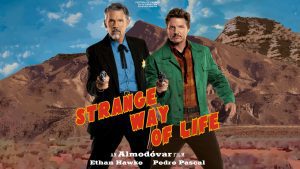
Strange Way of Life, directed by Pedro Almodóvar and produced by his brother, Augustin premiered this year (2023) in Cannes and brought attention beyond western heteronormativity. Starring Ethan Hawke and Pedro Pascal, the film, whose costumes were designed by Anthony Vaccarello, also had Saint Laurent as associate producer.

With 31 minutes, it incorporates the world of fashion by having costumes that say that the brand not only works with fine clothes like the suits and shirts that we see the sheriff and the cowboy wearing, but also makes casual clothes like jackets. Would it be a catalog from Saint Laurent itself or would it be a cinephile political act that says that the western is for everyone? Or more than that; Would it be an opening the way for short and medium-length films to be shown on the commercial circuit as well as at major festivals?

You can find Strange Way of life on the cinema and on 20th October on Mubi.

Did you like the content? So leave a comment to let me know!

See you in the next text.

Categories
Sem categoria

Dream

Dream emerges as a cinematographic example that, with skill, reveals the complexities of the human being in the face of emotional wounds and personal challenges. Lee Byeong-heon scripts and directs the feature that comes to the Netflix catalog after dominating the South Korean box office in 2023, challenges the conventions of sports comedy and can reach k-drama fans.

The film stars two great figures, Park Seo Joon and IU, whose performances bring depth and magnetism to each character they play. However, do not be fooled by the comic guise, as this narrative goes beyond the mere search for laughter, bringing trauma and disbelief, by weaving a scenario of mutual learning and collective overcoming.

Lee Byeong-heon weaves an exciting plot full of underlying meanings. The story follows the trajectory of Yoon Hong Dae, played by Park Seo Joon, an athlete who is on the brink of failure, whose career salvation is coaching a team of unfortunates, relegated to social marginality. Here, football transcends its sporting surface and, as a metaphor for life, becomes the very battle for existence, where endurance and determination are essential foundations on the journey.

Addressing the ambivalence between commitment and talent, the narrative subtly reveals that, in a world where some are ostracized, solidary support becomes the compass for reconciliation with oneself and with family members left behind. The victories are not only in the sporting sphere, but in building shared memories and strengthening bonds.

The narrative takes on additional contours with the inclusion of Lee Ji-eun as Lee So-min, a documentary filmmaker who records the arduous training sessions and matches, placing them in a unique film, the so-called ” Dream”. Through the journey of creating this documentary, it culminates in a metafilmic experience that portrays its stages as montage and voice-over in the editing and image capture island and execution of a documentary script throughout training and games.

Dream, in addition to promoting laughter and deep reflections, is a powerful visibility tool for the marginalized and excluded from society, showing their humanity and potential, a real punch in the stomach of social indifference. With subtle references to the Premier League, the film transcends geographic boundaries, reverently intertwining with European football and its icons, evoking nostalgia in viewers.

In essence, Dream constitutes an unmissable invitation for cinema aficionados who wish to appreciate the subtlety of the narrative and the impact of a plot that extends beyond the four lines of the field, rising to a human narrative full of courage and resilience.